

Allison Mackenzie Sponsors St. Teresa of Avila Catholic School’s 2022 Jog-A-Thon
Allison Mackenzie is a proud sponsor of the St. Teresa of Avila Catholic School’s 2022 Jog-A-Thon.
St. Teresa of Avila School is nestled in the Sierra Nevada foothills of Carson City, Nevada. For over 60 years, they have excelled in Catholic education. The Jog-A-Thon will take place on May 13th and will aim to raise money for the school and students.
The firm is dedicated to helping the school raise funds for their students’ education.
The results are in! Thank you Northern Nevada Business Weekly and everyone who voted for us! We are honored to have been named among so many talented companies and individuals. Congratulations to all of this year’s winners.
Soroptimist International of Carson City joins with our Partnership Sponsor, Allison MacKenzie, to invite businesses, nonprofits and local agencies to sponsor a woman from their company or from the community as a “Women Helping Women” Honoree in recognition of her dedication to improving the lives of women or girls.
Honorees will be recognized at the “Celebrating Women Helping Women” event to be held Casino Fandango on February 17, 2022 from 6:30 pm to 8 pm.
Through December 31, 2021, local businesses, nonprofits and agencies may sponsor an individual woman who has gone above and beyond, in her professional or volunteer work, to make a difference in the lives of women and girls.
Sponsors need to complete a “Women Helping Women” Honoree Recognition Form when submitting their sponsorship fee.
The forms are available on SI Carson City’s website at https://www.sicarsoncity.org or by request at sicarsoncity@gmail.com
SI Carson City recognizes that throughout our community, there are women who share their time, expertise, compassion and motivation to help other women or girls and they deserve to be acknowledged for those efforts.
Do you have an outstanding female staff member who provides a level of care and compassion that really sets her apart? Or an employee that volunteers in the community helping a nonprofit with its program efforts for women or girls?
Is there a board member or volunteer who has dedicated her time to making sure women or girls in our community have access to activities and resources that encourage their education, improve life skills, provide quality health care, or provide support in order to overcome family hardships?
Our “Celebrating Women Helping Women” event is the occasion to acknowledge her contributions and allow the community to express its gratitude and appreciation for her efforts.
Only twelve “Women Helping Women” will be honored and they will be announced in early January 2022 and provided event tickets and program advertising opportunities at that time.
Honorees with their sponsors will be invited to a private virtual reception before the event, will be recognized at the event, will receive a framed recognition certificate, have a profile page in the event program and be highlighted on the SI Carson City website and Facebook page.
The 2022 honorees will also have an engraved name plate added to the SI Carson City “Women Helping Women” plaque and join the 2020 and 2021 “Women Helping Women” honorees.
Please visit our Event: Celebrating Women Helping Women website page.
Soroptimist International of Carson City is a volunteer organization that provides women and girls with access to the education and training they need to achieve social and economic empowerment.
Founded in 1957, the Carson City club is part of Soroptimist International of the Americas and joins with Soroptimists in more than 120 countries around the world.

Premarital and Post-Nuptial Agreements as Estate Planning Tools
In Nevada premarital agreements and post-nuptial agreements are effective tools which can be utilized for estate planning needs. Premarital agreements are governed by NRS 123A. A premarital agreement is defined as an agreement between prospective spouses made in contemplation of marriage and to be effective upon marriage. This essentially means an agreement between you and your significant other made prior to marriage that sets forth specific obligations between the two of you. Post-nuptial agreements on the other hand are entered into by couples after marriage and not in contemplation of immediate divorce. Post-Nuptial agreements are not statutorily defined but have been acknowledged in case law.
In order for a premarital agreement to be enforceable the premarital agreement must be in writing and signed by both parties, the agreement must have been executed voluntarily, the agreement must not be unconscionable, and there must have been a full disclosure of all financial obligations and property of the parties or waiver of said disclosure. In order for a post-nuptial agreement to be enforceable it must be in writing and notarized by the parties, entered into voluntarily by the parties after marriage with the intent to stay married and living together and be recorded in any county in which real property owned by either party is located.
Premarital agreements may cover a variety of aspects between yourself and your fiancé. The most common reason someone would utilize a premarital agreement is to set forth the assets each party has going into the marriage and set forth the division of property to occur should the marriage end in divorce. Other issues which may be addressed in a premarital agreement include: the right to buy, sell, control or otherwise dispose of property; to set or eliminate the possibility of alimony; establish ownership rights or disposition of death benefits; and set forth other rights and obligations of the parties not in contravention of public policy or criminal statutes. It is important to note that one item which cannot be determined or set by a premarital agreement is child support. Child support must be set in accordance with the child support statutes in effect at the time of divorce.
As a general rule of thumb, when a couple becomes married, all assets acquired after the date of marriage are considered community property. Additionally, assets the parties owned prior to the marriage can easily become community property if the other party’s name is added to the account or title. Community property generally passes to the surviving spouse upon the death of the first spouse, as opposed to separate property which can be passed to beneficiaries through a will or other estate planning tool. Premarital agreements can be put in place prior to a marriage to limit or eliminate community property. Premarital agreement’s allow couples to elect to retain all of their property as separate property, keep all previously owned property as separate property and only allow newly acquired property to become community property or any combination thereof. A premarital agreement is ideal for couples who marry later in life and want to ensure their children receive their estates upon death rather than their new spouse.
Similarly, post-nuptial agreements can also dictate whether or not certain assets are to be considered community property or separate property. It is important to note that spousal support cannot be set by a post-nuptial agreement as defined above. The biggest difference between a premarital agreement and a post-nuptial agreement is that in a post-nuptial agreements the parties are entering into a contract with each other after marriage which changes community property to separate property instead of preserving the nature of separate property as dictated by Nevada law. As stated previously, changing the nature of property from community property to separate property is a way to ensure your estate planning desires are met.
If a premarital agreement or a post-nuptial agreement sound like something may benefit from, please contact Allison MacKenzie, Ltd. to set up a consultation.
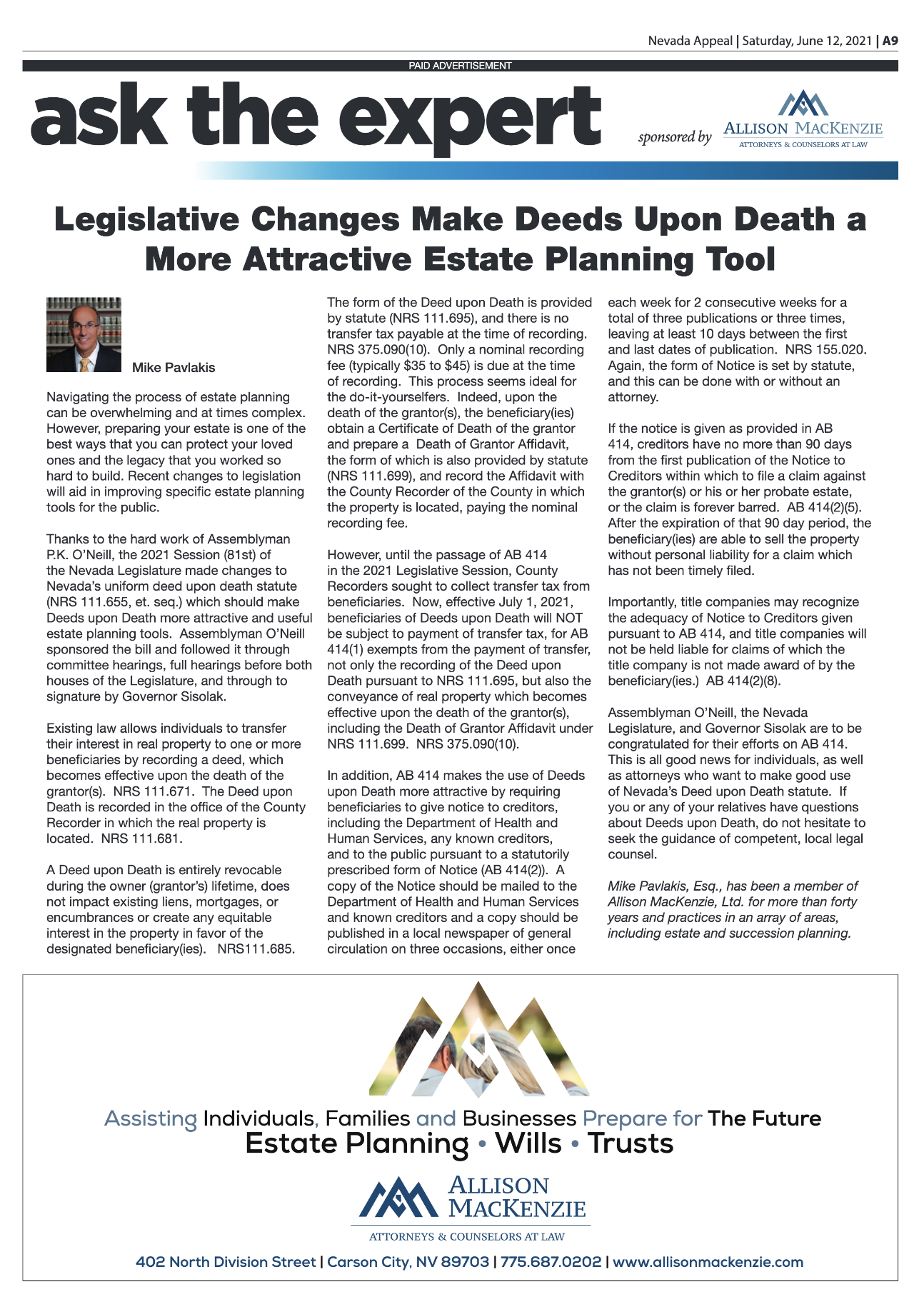
Highlights of the 2021 Nevada State Legislative Session
The 81st (2021) Session of the Nevada Legislature began February 1, and adjourned June 1. A total of 1,035 bills were proposed during the session, with less than a third making it to Nevada Governor Steve Sisolak’s desk for final approval.
Democrats Had the Numbers
The Democratic Party held a majority of the seats for both houses of the state Legislature. The Nevada House of Representatives consisted of 26 Democrats and 16 Republicans, while the Nevada State Senate was made up of 12 Democrats and nine Republicans. The most active sponsor for bills in the House was state Representative Selena Torres (D) with a total of 72 sponsored bills. In the Senate, state Senator Joseph Hardy (R) was responsible for 90 sponsored bills.
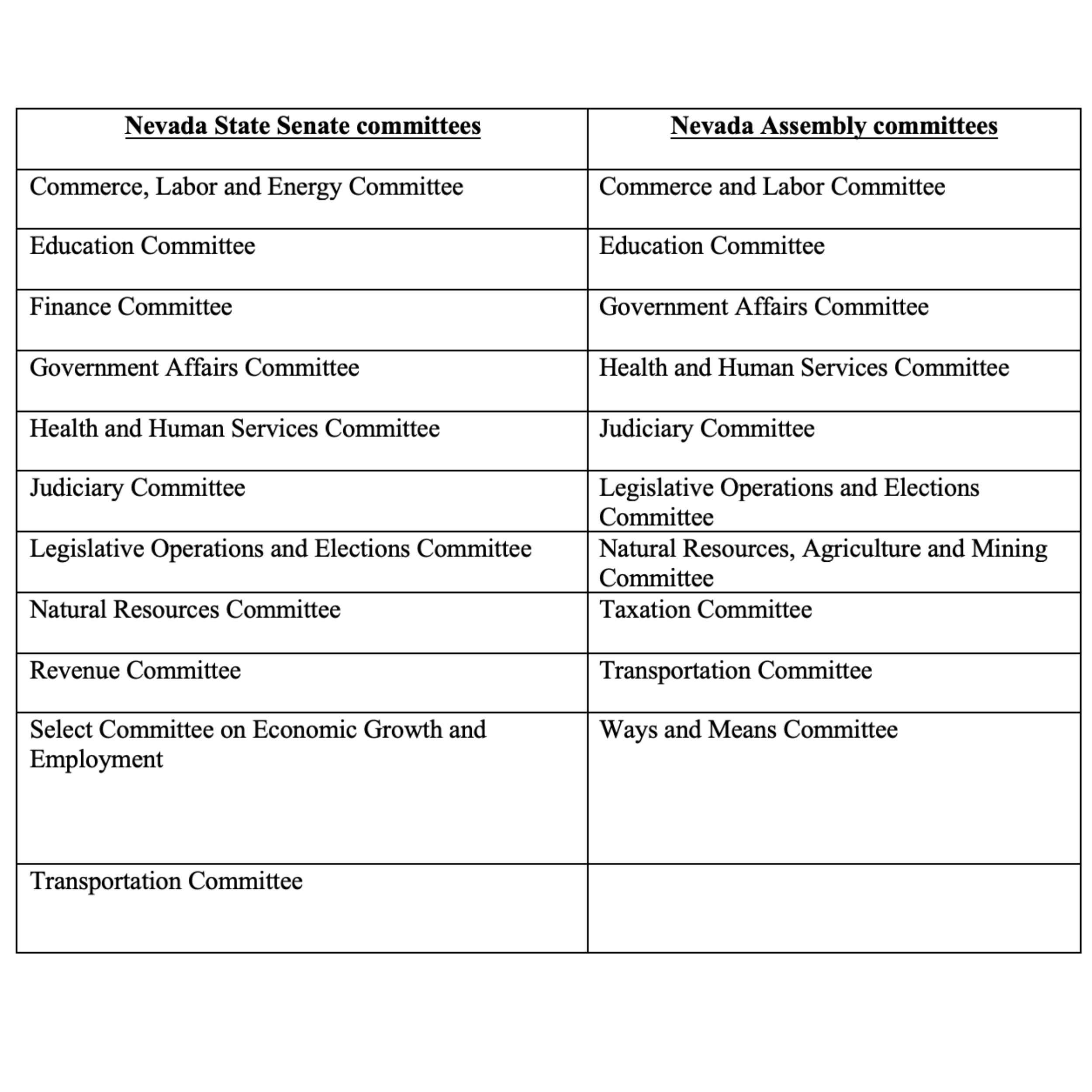
Committees
There are currently 21 state of Nevada committees that manage bills and legislation in their prospective, appointed domain subjects. Eleven of these are Senate committees, and 10 are state House committees. Each committee is formed with a specific area of governmental focus. See a list of committees below.
Controversial Bills Among Those That Failed
With only 322 of proposed bills passed, more than 700 sponsored bills failed to make it to the Governor’s office. Two such failed bills were Nevada Assembly Bill 395 and Nevada Senate Bill 452, both considered somewhat controversial. If passed, Nevada Assembly Bill 395 would have abolished the death penalty in the state of Nevada. While it did pass in the House with a 26-16 party-line vote, without Sisolak’s support, it lost momentum and died on the state Senate floor. Along the same lines, Nevada Senate Bill 452, which focused on prohibiting guns on casino property passed the state Senate but was not approved by the House.
Passage of Health-Related Bills
Though most proposed bills failed to move forward, some health-related bills did pass. This may be due, in part, to an increased focus on mental and physical health in the wake of the Covid-19 pandemic. Under Nevada Senate Bill 390, a suicide prevention and behavioral health crisis hotline will be created. Nevada Senate Bill 211 also passed, allowing patients easier access to testing for sexually transmitted diseases. Please reach out with questions regarding these bills or any of the other 320 bills passed this legislative session. We are well-versed on each bill passed, health-related and otherwise; and we are ready to provide legal advice, counsel, and representation on matters pertaining to these bills.
Questions? Please do not hesitate to contact us at 775-687-0202.
Works Cited:
2021 Nevada legislative session. Ballotpedia. (2021). https://ballotpedia.org/2021_Nevada_legislative_session.
Calderon, J., & Golonka, S. (2021, June 3). Nevada Legislature recap: Gun free casino zones, midwife license board among business-related bill casualties. Northern Nevada Business Weekly. https://www.nnbw.com/news/2021/jun/03/nevada-legislature-recap-gun-free-casino-zones-mid/.
Nevada Governor, Senate Leaders Block Death-Penalty Abolition Bill That Passed State Assembly. Death Penalty Information Center. (2021, May 19). https://deathpenaltyinfo.org/news/nevada-governor-senate-leaders-block-death-penalty-abolition-bill-that-passed-state-assembly.
Nevada State Legislative Dashboard. LegiScan. (2021). https://legiscan.com/NV.
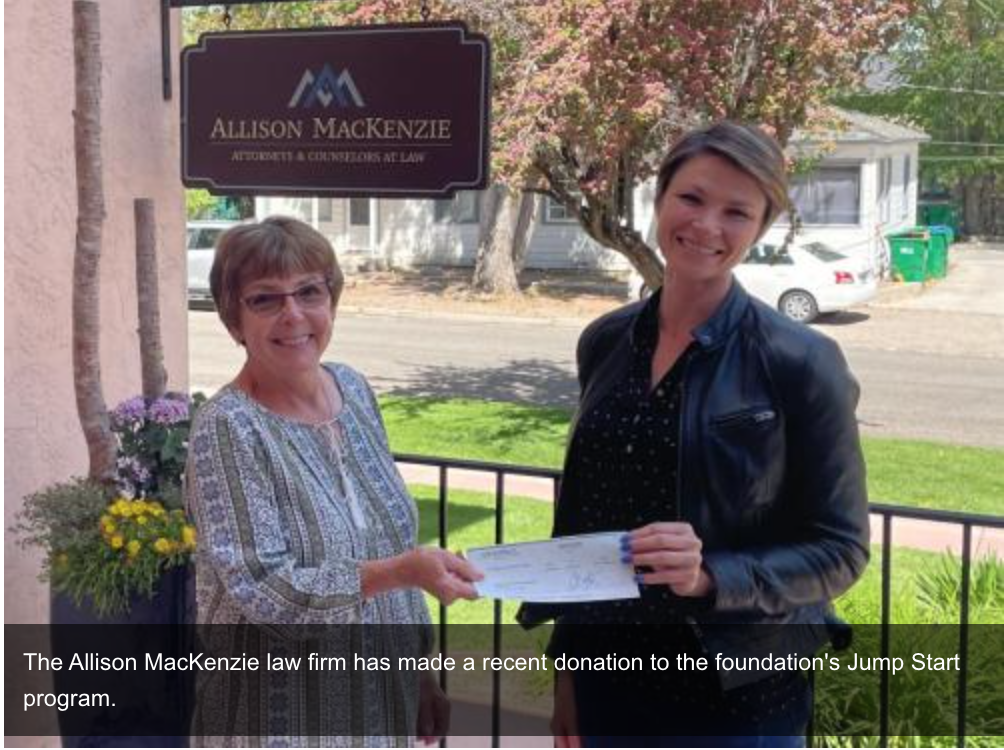
Daniel Davis, Carson City School District
We are proud to support this effort. Read the article below for more information about the project.
Featured in Carson Now: Carson City Schools Foundation still
needs support for dual-enrollment program
The Carson City Schools Foundation, in support of the Carson City School District, still seeks community donors to match its efforts to ‘Sponsor a Student’ for the Western Nevada College Jump Start College program.
From now through June 30, 2021, the foundation continues to support and will match community sponsorships up to $6,250 total to help make up the cost of textbooks and materials for the up-coming school year.
The Foundation has raised nearly 65 percent of their goal but is still counting on community partners to help fill the need.
“We have had an impressive start to this funding campaign, but we are still in need,” said CCSF Board Member Mike Jackson, president and CEO of The Micromanipulator Company. “We have a very generous community here in Carson City, and I know there are many businesses and community partners that would be more than willing to assist the Carson City Schools Foundation in supporting this effort.”
The Jump Start College program is a dual-enrollment opportunity for high school students to experience college courses through WNC while simultaneously earning high school credits. Jump Start College participants are able to complete up to 60 college credits through WNC, often earning them an associate’s degree around the same time they earn their high school diploma. Earning an associate’s degree while simultaneously graduating from high school helps participants save nearly two years’ worth of money in college tuition.
The grant funding for the joint program with WNC was canceled earlier this year. The Carson City School District plans to continue to support the program through the Distributive Student Account (DSA) as part of its commitment to College and Career Ready curriculum, but this support did not include the cost of books and materials.
The approximate cost for Jump Start College materials for the projected enrollment of 125 students is expected to be $12,500 or $100 per student. The Foundation has committed funds for half of the amount and is looking for community support in donations to match their commitment. If the foundation exceeds the total amount needed for Jump Start, additional funds raised and donated by the community will be added to other grant programs including Department and Individual Student grants and the foundation’s popular Mini-Grant program, which supports teachers and staff with funding for creative, educational projects traditional funding sources may not reach.
To make a contribution to help ‘Sponsor a Student’ for the Jump Start College program, please click here. For more information about the Carson City School’s Foundation, visit ccschoolsfoundation.org.
CCSF is a non-profit organization dedicated to promoting community involvement and investment in the public schools of Carson City. This project is one of the many results of the “Empower Carson City 2022″ Strategic Plan – a five-year strategic plan for extraordinary schools built by the community of Carson City.
CCSF was created to increase student achievement through philanthropic investment and involvement. Established by the Carson City School District’s Board of Trustees, the foundation promotes education programs that traditional funding sources may not be able to reach.
For more information about the CCSF, please visit ccschoolsfoundation.org. To make a contribution with your credit card, click here, or you may also donate by sending a check to the Carson City Schools Foundation at P.O. Box 92, Carson City, Nevada 89702. To view an informational video, please click here.
ABOUT Carson City School District
Located in Nevada’s capital, Carson City School District offers public education to approximately 7,800 students throughout Carson City. The district includes 6 elementary schools, 2 middle schools, 1 alternative high school and 1 comprehensive high school. Carson City School District boasts many successes including impressive graduation rates, strict safety measures, programs for gifted students and advanced-placement classes, among several others. In a joint venture with Western Nevada College, the Carson City School District Jump Start College program allows students to complete their senior year of high school and freshman year of college simultaneously. For more information, visit carsoncityschools.com.
We are proud to help support this effort. Check out the article below.
We are honored to have been awarded the Nevada Business Award 2021 by Nevada Business Magazine in the “Other’s First, Philanthropy and Giving” category!
Allison MacKenzie
EST. 1968
Originally known as Laxalt, Berry and Allison, the law firm Allison MacKenzie was founded by George Allison, Peter Laxalt and Robert Berry. The firm has made a commitment to serving northern Nevada and its leadership believe their success is directly tied to the strength of the community. One of the firm’s founders, George Allison, said it best. “I believe we all have a responsibility to pay forward the fortune of our own lives. I don’t think you can really be successful if the community around you is not also successful,” he said.
Read More: https://www.nevadabusiness.com/…/nevada-business-awards/
Renewable energy is considered the key to the future by many scientists, national business leaders, and political officials. It is a fast-growing industry that is rapidly gaining interest and support across the country due to growing environmental concerns. This is especially true for the state of Nevada, where there is an abundance of renewable energy sources such as solar energy and geothermal energy. In the year of 2020, one-third of the electricity generated in Nevada came from renewable energy sources. Therefore, it is vital that Nevadans be aware of the new and current laws/systems that govern renewable energy for the state. The most important of these recent changes being Question #6, the Renewable Energy Standards Initiative (2020).
What is Question #6?
The biggest and most recent change to Nevada’s renewable energy policy is the passage of Question #6, the Renewable Energy Standards Initiative (2020). This amendment requires state utilities to have at least 50% of the energy that they supply to Nevada communities be sourced from renewable resources by the year 2030. It also clarifies what is considered a renewable energy source by Nevada law. For example, solar, geothermal, wind, biomass, and hydroelectric have all been labeled as renewable under the initiative.
How did it happen?
This change of energy policy was proposed in an effort to force Nevada to shift towards more sustainable energy, as constitutional amendments are more difficult to repeal and/or alter when compared to normal state law. The campaign for the ballot initiative began in 2018 and was filed by the political action committee Nevadans for Affordable, Clean Energy Choices. More than 230,000 signatures were part of this filing as of June 18, 2018. In July, Secretary of State Barbara Cegavske certified the filing and the measure was placed on the 2018 ballot. For a constitutional amendment to be ratified in the Nevada constitution, the amendment must be approved in two consecutive elections. The first approval occurred in 2018, with the initiative being fully passed on November 3rd, 2020.
What Are the Potential Impacts?
Since the amendment was very recently created, there is still much debate about the pros and cons of the government action. Those who are pro the amendment claim that it will reduce state government spending by cutting the state’s dependence on imported energy generated from fossil-fuels. Furthermore, they claim it will increase investments and create new jobs for the state economy. On the other side, those who are against the amendment claim that it will place extra burdens on Nevada taxpayers as the state may not be able to self-produce enough renewable energy by the deadline and therefore rely on importing expensive energy produced by other states through renewable sources.
Any sweeping government action, such as this initiative, will raise many questions and concerns for a variety of people and organizations. This will be especially true for entities that are part of the energy production and distribution systems in Nevada. If you have these questions or concerns, do not hesitate to contact a representative of Allison MacKenzie. We will do our utmost to address your concerns.
Works Cited:
Alonzo, Amy. “Question 6: Increasing Nevada’s Reliance on Renewable Energy to 50 Percent by 2030.” Reno Gazette Journal, Reno Gazette Journal, 11 Oct. 2020, www.rgj.com/story/news/2020/10/11/nevada-question-6-would-increase-reliance-renewable-energy/5887968002/.
“Nevada – State Energy Profile Analysis.” U.S. Energy Information Administration – EIA – Independent Statistics and Analysis, U.S. Energy Information Administration, 18 Feb. 2021, www.eia.gov/state/analysis.php?sid=NV.
“Nevada Question 6, Renewable Energy Standards Initiative (2020).” Ballotpedia, ballotpedia.org/Nevada_Question_6,_Renewable_Energy_Standards_Initiative_(2020).
“Renewable Energy Explained.” U.S. Energy Information Administration – EIA – Independent Statistics and Analysis, U.S. Energy Information Administration, www.eia.gov/energyexplained/renewable-sources/.
Congratulations to Joel W. Locke on his appointment to the Nevada Commission on Judicial Selection. Read more below.
James Cavilia, Managing Partner of Carson City-based law firm Allison MacKenzie, announced March 24 that attorney Joel W. Locke has been appointed to the Nevada Commission on Judicial Selection. 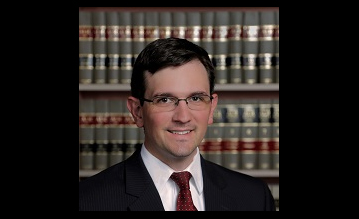
The Nevada Commission on Judicial Selection is charged with filling judicial vacancies that occur before expiration of a term of office in the Supreme Court, Court of Appeals or District Court.
One permanent member is appointed by the State Constitution, two permanent members are appointed by Governor, and three permanent members are appointed by the State Bar of Nevada. Locke was appointed by the State Bar of Nevada and will serve a four-year term, according to a press release.
Locke joined Allison MacKenzie in 2007 and practices in a variety of areas, including estate planning, probate, labor and employment and business law.
He graduated with a Bachelor of Science in Finance from the University of Nevada, Reno, in 2000. He obtained his law degree from Gonzaga University School of Law in 2006. Locke serves on the Board of Governors for the State Bar of Nevada and is also a Judge Pro Tem for the Carson City Justice and Municipal Courts.


 402 North Division Street Carson City, Nevada 89703 |
  775.687.0202 |
  info@allisonmackenzie.com
Copyrights ©2026, The Company Name. All rights reserved.